Industrial Marble Cutting Machines: Types, Technology, and Applications
Industrial marble cutting machines are specialized systems designed to cut, shape, size, and finish marble and other natural stone materials. Marble is widely used in flooring, wall cladding, countertops, staircases, monuments, furniture, and architectural decoration. Because natural stone is heavy, dense, and valuable, accurate cutting is important for reducing material waste and achieving consistent dimensions.
These machines exist because traditional manual cutting methods can be slow and difficult to control when processing large blocks or thick slabs. Industrial equipment uses mechanical systems, diamond tools, computer controls, water cooling, and automated movement to perform cutting operations with greater consistency.
The global stone-processing sector now includes a wide range of equipment. Some machines are designed for basic straight cuts, while others use CNC systems to create complex curves, shapes, holes, edges, and decorative patterns. The right technology depends on the material thickness, production volume, design requirements, and desired surface finish.
Why Industrial Marble Cutting Machines Matter Today
Modern construction and interior design require accurate stone components. A small dimensional error can affect installation, alignment, and the appearance of a finished project. Industrial marble cutting machines help manufacturers and fabricators create more consistent pieces for residential, commercial, hospitality, public, and architectural applications.
These machines also support better material planning. Digital design software can help prepare cutting layouts before production begins. This allows operators to study slab dimensions and plan cuts more efficiently.
Key benefits include:
- Improved dimensional accuracy
- Consistent cutting quality
- Better handling of large marble slabs
- Support for complex shapes and designs
- Reduced manual handling during repetitive operations
- Greater production flexibility
- Improved water and dust-control systems
- Easier integration with digital design workflows
The technology affects stone-processing plants, architectural workshops, construction projects, interior designers, engineers, and manufacturers of marble products. It also supports the broader trend toward digital manufacturing, where computer-aided design and automated machinery work together.
Safety is another important reason for modern machine development. Cutting stone can create dust and involves rotating tools, heavy materials, water, electricity, and moving components. Modern systems increasingly include guards, emergency stops, sensors, enclosed cutting areas, and improved dust-control methods.
Main Types of Industrial Marble Cutting Machines
Bridge Saw Machines
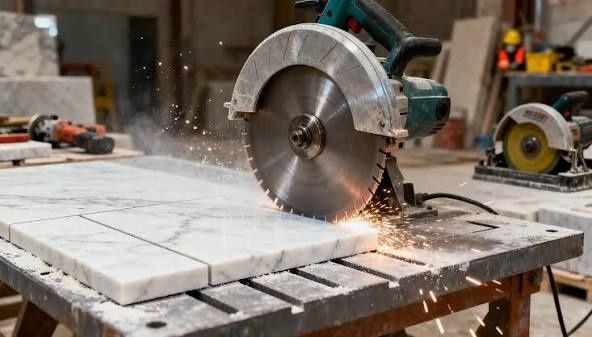
Bridge saws are among the most widely used systems for cutting marble slabs and tiles. A bridge structure moves the cutting head across the material while a diamond blade performs the cut.
Many modern bridge saws use digital controls for setting cutting length, angle, and movement. They are commonly used for straight cuts and, depending on the design, may also perform angled or mitre cuts.
CNC Marble Cutting Machines
CNC marble cutting machines use computer-controlled movement to guide cutting tools. These systems can process programmed designs and are suitable for complex shapes, curves, openings, and detailed architectural components.
A CNC workflow often begins with a digital drawing or CAD model. The design is converted into machine instructions, allowing the cutting head to follow a defined path.
CNC systems are useful when precision and repeatability are important. They can support applications such as custom countertops, decorative panels, medallions, columns, sinks, and artistic stone components.
Waterjet Cutting Machines
Waterjet cutting systems use a high-pressure water stream, often combined with an abrasive material, to cut stone. The process can create intricate patterns and detailed shapes.
Waterjet technology is especially useful for decorative inlays, mosaics, geometric designs, logos, and complex architectural patterns. Since the cutting method does not rely on a conventional rotating blade in the same way as standard saws, it can provide greater design flexibility for certain applications.
Wire Saw Machines
Wire saws use a diamond-coated wire to cut large stone blocks or thick sections. They are often used where large-scale cutting is required.
The cutting process can be suitable for quarrying and primary block processing. Advanced systems may include automated tension control, programmable movement, and monitoring features to improve consistency.
Multi-Blade Cutting Machines
Multi-blade machines use several blades to cut a stone block into multiple slabs during one operation. These systems are designed for high-volume processing environments.
The main advantage is the ability to create several cuts in a coordinated process. Blade configuration, spacing, material characteristics, and machine settings all influence the final result.
Edge-Cutting and Profiling Machines
Edge-cutting and profiling machines are designed to shape the sides of marble components. They can create polished edges, bevels, rounded profiles, grooves, and other finishing details.
These systems are commonly used after primary cutting when the final component requires a specific edge design.
Technology Trends in Marble Cutting Equipment
Industrial marble cutting technology is moving toward greater automation and digital integration. CNC control, CAD/CAM software, sensors, programmable systems, and automated material handling are becoming increasingly important in modern production environments.
One major trend is the use of digital cutting plans. Operators can prepare a layout before cutting begins, helping them understand how different shapes will fit within a slab or block.
Another development is improved machine monitoring. Sensors can track factors such as blade condition, temperature, vibration, water flow, and operating status. These systems can help identify unusual conditions before they develop into larger operational problems.
Automation is also becoming more important for repetitive tasks. Robotic systems and automated handling equipment may help move heavy slabs, position materials, or transfer finished pieces between stages.
Energy and water management are additional areas of attention. Wet cutting remains important for controlling dust, but water circulation and filtration systems can help manage water use. Equipment designers are also developing more efficient motors, controls, and operating systems.
Recent developments through 2025 and into 2026 have continued to emphasize automation, digital production planning, machine safety, and dust exposure control. Machinery regulations and workplace health requirements are also influencing how new equipment is designed and operated. The European Union's Machinery Regulation 2023/1230 is scheduled to apply from 20 January 2027, creating an important future compliance milestone for machinery placed on the EU market.
Laws, Safety Rules, and Industry Policies
Rules for industrial marble cutting machines vary by country and region. Businesses and machine operators should follow the laws that apply to their location, workplace, equipment type, and material.
In the United States, workplace rules address machine guarding and exposure to respirable crystalline silica. Cutting, sawing, grinding, and other high-energy stone operations can generate very small airborne particles. OSHA identifies engineering controls, including wet methods and local exhaust ventilation, as important methods for reducing exposure.
Machine guarding is also important. Cutting areas should be designed to reduce access to dangerous moving parts, and safety systems should be inspected and maintained according to applicable workplace requirements.
In the European Union, machinery placed on the market must meet applicable safety and conformity requirements. Regulation (EU) 2023/1230 will replace the existing machinery framework from 20 January 2027. It includes requirements related to machinery design, technical documentation, conformity assessment, and safety.
Other countries may have their own requirements covering:
- Machine guarding
- Electrical safety
- Noise exposure
- Dust control
- Workplace training
- Environmental management
- Wastewater handling
- Product conformity
- Emergency procedures
Because rules can change, manufacturers and operators should check the current requirements of the relevant national and local authorities.
Tools and Resources for Understanding Marble Cutting Technology
Several general tools can help users plan, operate, and understand industrial marble cutting systems.
- CAD software: Used to create digital drawings and cutting layouts.
- CAM software: Converts design information into machine instructions.
- Nesting tools: Help arrange shapes on slabs to improve material planning.
- Measurement systems: Digital measuring devices support dimensional checks.
- Machine monitoring software: Tracks operating conditions and equipment status.
- Maintenance checklists: Help organize inspections of blades, pumps, guards, motors, and control systems.
- Dust-control assessment tools: Help evaluate workplace exposure and control methods.
- Safety training templates: Provide structured guidance for operator instruction.
- Production planning spreadsheets: Help organize materials, cutting sequences, dimensions, and production schedules.
- Technical manuals and standards databases: Help users understand machinery requirements and safe operating practices.
The best resource depends on the machine type and the specific production environment. A basic bridge saw may require different planning tools from a multi-axis CNC system.
Frequently Asked Questions
What is an industrial marble cutting machine used for?
It is used to cut, shape, size, and finish marble and other natural stone materials. Applications include slabs, tiles, countertops, flooring, wall panels, architectural components, decorative patterns, and monuments.
Which machine is suitable for complex marble designs?
CNC machines and waterjet cutting systems are commonly used for complex designs. CNC equipment can follow programmed paths, while waterjet systems can create detailed shapes, patterns, and inlays.
Why is water used during marble cutting?
Water can help cool cutting tools and reduce airborne dust created during cutting. Wet cutting is also an important engineering control for reducing exposure to dust generated by certain stone-processing activities.
Are CNC marble cutting machines fully automatic?
Not always. The level of automation depends on the machine model and production setup. Some systems require operators to load material and monitor the process, while advanced installations may include automated handling, digital programming, sensors, and integrated production systems.
What safety factors are important when operating marble cutting equipment?
Important factors include machine guarding, emergency stop systems, safe material handling, appropriate dust controls, electrical safety, operator training, equipment inspection, and compliance with applicable workplace regulations.
Conclusion
Industrial marble cutting machines have developed from basic mechanical cutting equipment into advanced systems that combine diamond tools, water management, CNC controls, digital design, automation, and monitoring technologies. Different machine types serve different purposes, from straight slab cutting to complex decorative designs and large-scale block processing.