Advanced Pipe Extrusion Lines for Modern Plastic Manufacturing
Plastic pipe production has become an important part of modern infrastructure, construction, agriculture, water management, and industrial operations. Advanced pipe extrusion lines provide a controlled way to transform plastic materials into continuous pipes with consistent dimensions and performance characteristics.
Modern extrusion technology combines material preparation, heating, forming, cooling, sizing, cutting, and quality monitoring into an integrated production process. Improvements in automation, energy management, process control, and material efficiency are making these systems more adaptable to changing manufacturing requirements.
For manufacturers and technical professionals researching plastic pipe manufacturing technology, understanding how extrusion lines work can help explain why different equipment configurations are used for different pipe materials, diameters, wall thicknesses, and applications.
Context: What Are Pipe Extrusion Lines?
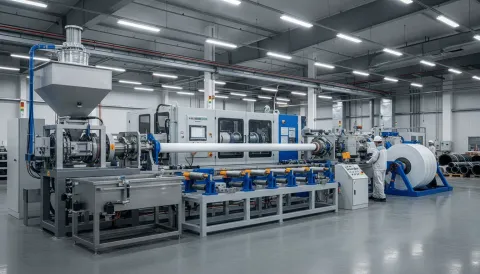
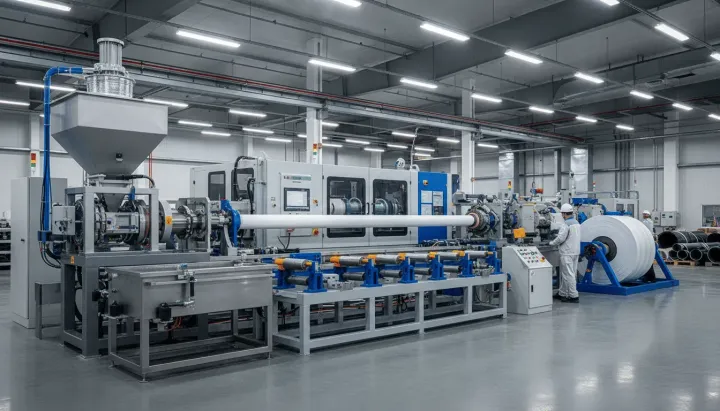
A pipe extrusion line is an integrated production system designed to continuously manufacture plastic pipes. The process generally begins with plastic pellets or other prepared polymer materials.
The material enters an extrusion unit where controlled heat and mechanical pressure transform it into a homogeneous melt. The molten polymer then passes through a specially designed die that shapes it into a tubular profile.
After leaving the die, the pipe passes through sizing and cooling equipment. It is then pulled at a controlled speed and moved toward downstream equipment for cutting, coiling, or other finishing operations.
Common materials used in pipe extrusion include:
- Polyethylene (PE)
- High-density polyethylene (HDPE)
- Polypropylene (PP)
- Polyvinyl chloride (PVC)
- Cross-linked polyethylene (PEX), in specialized processes
- Other engineered thermoplastic compounds
The configuration of an extrusion line depends on the material and final pipe specifications. A small-diameter flexible pipe may require a different setup from a large-diameter pressure pipe.
Key components can include:
- Material feeding systems
- Extruders
- Heating and temperature-control zones
- Pipe dies
- Vacuum sizing tanks
- Cooling tanks
- Haul-off units
- Cutting equipment
- Coiling systems
- Printing or marking units
- Online inspection equipment
- Central control systems
Importance: Why Advanced Extrusion Technology Matters
The demand for reliable piping continues to grow because pipes are used in water distribution, drainage, irrigation, construction, telecommunications, industrial fluid handling, and infrastructure development.
Advanced extrusion systems help manufacturers maintain more consistent production conditions. Precise temperature, pressure, speed, and cooling control can influence pipe dimensions and material characteristics.
This is especially important for applications where dimensional accuracy is critical.
For example, variations in wall thickness can affect the mechanical behavior and installation characteristics of a pipe. Automated process monitoring can help identify changes during production before they become larger quality problems.
The technology also supports industrial automation, process control systems, energy-efficient manufacturing, and smart manufacturing strategies.
Important advantages of modern extrusion technology include:
- More precise process control
- Consistent pipe dimensions
- Automated production monitoring
- Improved material utilization
- Better production data collection
- Flexible product configuration
- Reduced manual intervention
- Improved quality inspection
- More efficient temperature management
Applications Across Major Industries
Pipe extrusion technology supports several important sectors.
Construction: Plastic pipes are widely used for drainage, water distribution, electrical protection, and building infrastructure.
Agriculture: Irrigation systems use various polyethylene and other thermoplastic pipes for controlled water distribution.
Water Management: Municipal and infrastructure projects use plastic piping for water and wastewater networks.
Telecommunications: Specialized ducts and conduits can protect communication cables and fiber-optic infrastructure.
Industrial Applications: Thermoplastic pipes may be used for transporting compatible fluids and supporting industrial process systems.
The appropriate pipe material and manufacturing configuration depend on pressure requirements, temperature, chemical exposure, environmental conditions, and applicable standards.
Recent Updates and Industry Trends
The pipe extrusion industry has continued to develop through greater automation and digital process monitoring during 2025 and 2026.
One important trend is the expansion of Industry 4.0 manufacturing. Modern extrusion lines increasingly incorporate sensors and digital control systems that monitor temperature, pressure, speed, material flow, and equipment conditions.
Another developing area is predictive equipment monitoring. Instead of relying entirely on scheduled inspections, manufacturers can use production data to identify unusual operating patterns and potential equipment issues.
Energy efficiency is also receiving greater attention. Extrusion requires significant thermal energy, so manufacturers are examining improved heating systems, insulation, motor efficiency, cooling management, and process optimization.
Material circularity is another major trend. Greater attention is being given to recycled polymer content and controlled material recovery where technical specifications allow it.
Recent developments include:
| Trend | Manufacturing Impact |
|---|---|
| Digital process monitoring | Better production visibility |
| Automated controls | More consistent operating conditions |
| Energy management | Improved resource efficiency |
| Recycled polymer integration | Greater material circularity |
| Inline inspection | Earlier identification of quality variation |
| Data analytics | Better process evaluation |
| Modular line design | Greater production flexibility |
Artificial intelligence and machine-learning techniques are also being explored for industrial data analysis, anomaly detection, quality prediction, and process optimization. Their practical usefulness depends on data quality, system integration, and appropriate engineering validation.
Laws or Policies Affecting Plastic Pipe Manufacturing
Plastic pipe production is influenced by environmental, product-quality, workplace-safety, and waste-management regulations. Exact requirements vary by country and by the intended application of the pipe.
In the European Union, manufacturers can encounter requirements connected with chemical management, environmental protection, waste reduction, and product standards. Regulations concerning substances and plastics can influence material selection and documentation.
In the United States, environmental and workplace requirements can affect polymer processing facilities, emissions management, waste handling, and worker protection. Product requirements can also vary according to whether pipes are intended for water, drainage, gas, electrical protection, or other applications.
In India, plastic manufacturing is influenced by environmental regulations, plastic waste management requirements, occupational safety considerations, and applicable product standards. Requirements can differ according to material, application, facility characteristics, and applicable national standards.
Manufacturers should evaluate relevant requirements before selecting materials or configuring a production line. Important areas can include:
- Polymer and chemical compliance
- Plastic waste management
- Workplace safety
- Machinery safety
- Product testing
- Dimensional standards
- Environmental controls
- Material traceability
- Packaging and waste requirements
Regulatory requirements can change over time, so current national and regional rules should always be verified before implementation.
Tools and Resources for Extrusion Planning
Several types of tools can help engineers, production teams, and researchers understand or evaluate pipe extrusion operations.
Extrusion Process Calculators:
These can help estimate material throughput, extrusion speed, cooling requirements, and other process parameters.
Material Property Databases:
Polymer data resources provide information about density, melting behavior, mechanical characteristics, and temperature ranges.
Energy Monitoring Tools:
Production energy dashboards can help track electricity and thermal energy use across different stages of an extrusion process.
CAD and Die Design Software:
Computer-aided design tools can support die geometry, pipe dimensions, equipment layouts, and production-line planning.
Quality Control Templates:
Digital inspection sheets can record wall thickness, outer diameter, ovality, surface condition, temperature, and other quality indicators.
Maintenance Checklists:
Structured maintenance templates can help track inspections of heaters, motors, gearboxes, cooling systems, vacuum equipment, sensors, and control components.
Standards Databases:
Technical standards resources can help identify applicable specifications for particular pipe materials and applications.
Factors to Consider When Evaluating an Extrusion Line
Selecting an appropriate configuration requires more than looking at machine capacity. The complete production requirement should be considered.
Material type is one of the first factors because different polymers have different processing characteristics.
Pipe diameter and wall thickness also influence extruder size, die design, cooling capacity, haul-off requirements, and downstream equipment.
Production speed should be considered together with quality requirements. Higher throughput does not automatically mean better manufacturing performance if dimensional stability or cooling capacity becomes difficult to maintain.
Automation level is another consideration. A highly automated system may integrate sensors, centralized controls, data recording, alarms, and automated adjustments.
Other evaluation factors include:
- Required pipe dimensions
- Polymer characteristics
- Expected throughput
- Cooling capacity
- Dimensional tolerance
- Quality inspection requirements
- Energy consumption
- Factory space
- Maintenance requirements
- Data and automation capabilities
- Applicable standards
A balanced assessment helps ensure that the extrusion line matches the intended manufacturing environment.
Frequently Asked Questions
What is a plastic pipe extrusion line?
A plastic pipe extrusion line is an integrated production system that heats and shapes polymer material into continuous pipe before cooling, sizing, pulling, and finishing it.
Which materials are commonly used for pipe extrusion?
Common materials include PE, HDPE, PP, PVC, and other thermoplastic compounds. Material selection depends on the required application and technical specifications.
How does automation improve pipe extrusion?
Automation can monitor and control operating parameters such as temperature, pressure, speed, and material flow. It can also improve production data collection and process consistency.
Why is cooling important in pipe extrusion?
Cooling helps the extruded polymer retain the required shape and dimensions. Proper cooling conditions are important for dimensional stability and product quality.
Are recycled plastics used in pipe manufacturing?
Recycled polymers can be used in some pipe applications when their properties, quality, and applicable technical requirements are appropriate. The permitted content depends on the product and its intended use.
Conclusion
Advanced pipe extrusion lines are becoming increasingly connected, automated, and data-driven. Their role extends beyond simply forming plastic into pipes. Modern systems combine extrusion technology, temperature control, cooling, dimensional measurement, automation, and quality monitoring into an integrated manufacturing process.