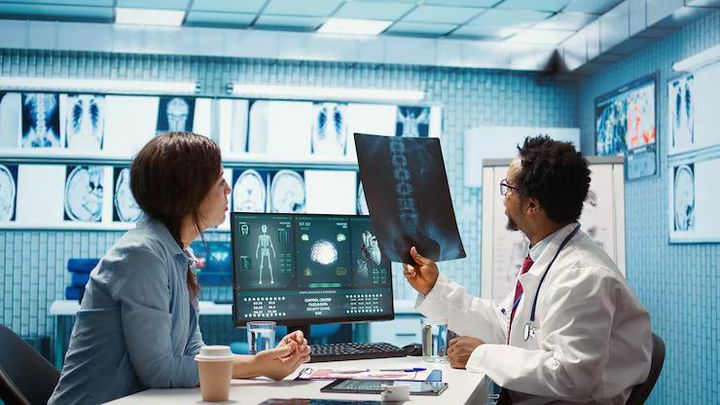
AI in Healthcare Diagnostics: Insights Into Modern Diagnostic Technology
Artificial intelligence (AI) in healthcare diagnostics refers to computer-based technologies that analyze health information and identify patterns that may help clinicians understand diseases and medical conditions. These systems can process medical images, laboratory results, physiological measurements, electronic health records, and other forms of clinical data.
Traditional diagnosis depends heavily on clinical knowledge, medical examinations, laboratory testing, imaging, and professional interpretation. AI does not remove the need for these processes. Instead, it can help organize large amounts of information and highlight patterns that may require closer clinical attention.
AI diagnostic technology exists because healthcare generates enormous volumes of data. A single medical image can contain thousands of details, while modern hospitals may manage information from imaging systems, laboratory equipment, patient histories, monitoring devices, and clinical records.
Machine learning allows computer systems to learn patterns from carefully prepared datasets. Deep learning, a branch of machine learning, is particularly important for medical imaging because it can identify complex visual patterns. Newer multimodal AI systems can work with several types of information, such as text, images, and structured clinical data.
Common applications include:
- Medical image analysis for radiology and pathology
- Detection of patterns associated with certain diseases
- Analysis of laboratory and diagnostic test results
- Risk assessment and clinical decision support
- Patient monitoring and abnormality detection
- Organization and summarization of medical information
- Research involving large healthcare datasets
The objective is generally to support better-informed clinical decisions rather than replace healthcare professionals. Human review remains important because diagnostic decisions involve medical history, symptoms, physical findings, patient preferences, and contextual information that an algorithm may not fully understand.
Importance
AI in healthcare diagnostics matters because modern healthcare systems must process increasingly complex information while maintaining accuracy, safety, privacy, and consistency.
For radiologists, pathologists, cardiologists, laboratory professionals, and other healthcare specialists, AI can help prioritize information and identify patterns that might otherwise require extensive manual review. In some situations, this can support earlier attention to potentially important findings.
Medical imaging is one of the most established areas of healthcare AI. Algorithms can analyze X-rays, CT scans, MRI images, ultrasound examinations, retinal images, and other diagnostic material. Depending on their intended use and validation, these systems may assist with image classification, measurement, segmentation, or detection.
AI can also support laboratory diagnostics. Algorithms can examine combinations of laboratory measurements and historical information to identify patterns associated with specific conditions. However, laboratory results should still be interpreted in their clinical context.
Another important area is clinical decision support. AI systems may combine information from multiple sources and present relevant patterns to clinicians. This can be useful when healthcare professionals need to consider a large amount of information within a limited period.
The technology affects several groups:
- Patients: Potentially improved access to data-supported diagnostic assessment.
- Clinicians: Additional analytical support during diagnostic workflows.
- Laboratory professionals: Assistance with complex data interpretation.
- Hospitals: Better organization and prioritization of diagnostic information.
- Researchers: New methods for studying large medical datasets.
- Healthcare policymakers: New opportunities for population-level analysis and planning.
However, AI also creates important challenges. Poor-quality training data can produce unreliable results. An algorithm trained primarily on one population may perform differently in another population. Bias, privacy risks, cybersecurity threats, limited transparency, and inappropriate reliance on automated recommendations can affect patient safety.
Therefore, accuracy alone is not enough. Effective healthcare AI requires appropriate validation, human oversight, monitoring, data governance, and clear accountability.
Recent Updates
AI healthcare diagnostics continued to develop rapidly during 2025 and 2026.
In March 2025, the World Health Organization published guidance addressing ethics and governance for large multimodal AI models in health. The guidance highlighted opportunities while emphasizing risks involving safety, equity, transparency, accountability, and governance.
In 2025 and 2026, regulatory attention also increased around AI-enabled medical devices. The U.S. Food and Drug Administration maintains an AI-enabled medical device list and continues updating information about authorized devices. Its published list includes diagnostic technologies across areas such as radiology and cardiovascular medicine.
The FDA also published important digital-health guidance updates during 2025 and 2026. These included guidance concerning clinical decision-support software, cybersecurity considerations for medical devices, and predetermined change-control plans for AI-enabled device software.
In February 2026, India launched its Strategic Framework for AI in Health. The framework describes a national approach for responsible AI adoption in healthcare and recognizes applications including diagnostics, health surveillance, research, and healthcare operations.
In April 2026, WHO published a discussion paper examining AI in evidence-informed health policymaking. It emphasized human judgment, multidisciplinary collaboration, data governance, risk-based regulation, and responsible implementation.
In June 2026, WHO/Europe published implementation insights on AI in healthcare, reflecting growing attention toward practical deployment rather than technology development alone.
In July 2026, WHO/Europe reported that nearly two-thirds of countries in its regional assessment were already deploying AI in diagnostics, while governance and health-specific AI strategies remained less widespread.
These developments show a broader shift from simply asking whether AI can perform a diagnostic task toward asking whether it can be implemented safely, fairly, transparently, and responsibly.
Laws and Policies
Healthcare AI is affected by several layers of regulation. The exact requirements depend on the country, intended use, medical risk, type of technology, and whether the software qualifies as a medical device.
In the United States, AI-enabled medical devices can fall under the FDA's medical-device regulatory framework. Developers may need to demonstrate appropriate safety and effectiveness according to the intended use and applicable regulatory pathway. The FDA also monitors lifecycle considerations for AI-enabled device software.
In India, healthcare AI is developing within a broader digital-health and data-governance environment. The 2026 Strategic Framework for AI in Health provides an important policy direction for responsible AI adoption. Healthcare organizations also need to consider applicable privacy, medical-device, digital-health, and clinical-governance requirements relevant to their specific application.
Internationally, WHO emphasizes several principles for responsible AI in healthcare:
- Human oversight
- Protection of privacy
- Transparency and explainability
- Safety and effectiveness
- Fairness and equity
- Accountability
- Appropriate evidence and validation
Regulatory requirements can change as AI technology develops. Organizations should therefore evaluate current national rules before implementing a diagnostic AI system in clinical practice.
Tools and Resources
Several general tools can help users understand and evaluate AI in healthcare diagnostics.
Medical imaging datasets: Curated research datasets can help students and researchers understand how image-based machine learning is developed and evaluated.
Statistical analysis tools: Statistical software can be used to examine diagnostic accuracy, sensitivity, specificity, predictive values, and other performance measures.
Machine learning frameworks: Programming frameworks can support experimentation with classification, image analysis, natural language processing, and predictive models.
Clinical decision-support evaluation templates: Structured templates can help document intended use, clinical workflow, limitations, validation methods, and human oversight.
Data-quality checklists: These can help teams review missing values, inconsistent records, demographic representation, labeling quality, and dataset limitations.
Risk-assessment frameworks: Risk-based frameworks can help organizations evaluate patient safety, privacy, cybersecurity, bias, and operational risks before deployment.
Regulatory databases: Government medical-device databases can help researchers identify authorized AI-enabled technologies and understand regulatory classifications.
Educational resources: Universities, public health organizations, medical associations, and international health organizations provide introductory material covering AI ethics, medical imaging, machine learning, and digital health governance.
A useful evaluation process should consider more than technical accuracy. Questions about dataset quality, clinical relevance, population diversity, workflow integration, cybersecurity, monitoring, and accountability are equally important.
FAQs
What is AI in healthcare diagnostics?
AI in healthcare diagnostics uses algorithms to analyze medical information and identify patterns that may assist healthcare professionals with diagnosis, screening, monitoring, or clinical decision-making.
Can AI replace doctors in diagnosis?
AI is generally designed to support rather than replace clinical professionals. Diagnostic decisions require medical judgment, patient history, examination findings, and contextual understanding that may not be fully represented in an algorithm.
Where is AI most commonly used in diagnostics?
Medical imaging is one of the major areas, including radiology, pathology, ophthalmology, cardiology, and ultrasound. AI is also being studied for laboratory analysis, risk assessment, patient monitoring, and clinical decision support.
What are the main risks of AI diagnostics?
Important risks include biased datasets, inaccurate predictions, privacy concerns, cybersecurity vulnerabilities, insufficient validation, limited transparency, and excessive reliance on automated recommendations.
Why is human oversight important?
Human oversight allows healthcare professionals to review AI-generated findings, consider patient-specific information, recognize unusual situations, and make informed clinical decisions when automated results are uncertain or inappropriate.
Conclusion
AI in healthcare diagnostics is becoming an important part of modern diagnostic technology. Its ability to process large datasets and recognize complex patterns can support medical imaging, laboratory analysis, patient monitoring, and clinical decision-making.
Disclaimer: The information provided in this article is for informational purposes only. We do not make any claims or guarantees regarding the accuracy, reliability, or completeness of the information presented. The content is not intended as professional advice and should not be relied upon as such. Readers are encouraged to conduct their own research and consult with appropriate professionals before making any decisions based on the information provided in this article.