Cable Production Lines: Explore Industrial Equipment and Manufacturing Stages
Cable production lines transform raw materials into cables. These manufacturing systems combine several machines and processes to produce wires and cables for electrical, communication, automotive, construction, and industrial applications. Each stage performs a specific function, from preparing metal conductors to applying insulation and protective coverings.
A modern cable production line may include wire drawing machines, bunching equipment, stranding systems, extrusion machinery, cooling units, and finishing equipment. The complete arrangement depends on the cable design, conductor material, required dimensions, and intended application.
What Is a Cable Production Line?
A cable production line is an integrated manufacturing setup designed to convert metal materials and insulating compounds into finished cable products. Copper and aluminium are commonly used as conductor materials because of their electrical properties.
These production systems can manufacture different cable types, including power cables, communication cables, control cables, automotive wires, and industrial cables. Some facilities operate dedicated production lines, while others use flexible machinery for multiple cable designs.
Importance of Industrial Cable Manufacturing
Why Cable Manufacturing Matters
Cables support electricity distribution, communication networks, transportation systems, and industrial operations. Their quality and construction influence electrical performance, mechanical strength, and resistance to environmental conditions.
Industrial cable machinery helps manufacturers perform repetitive production operations with greater process consistency. Proper equipment selection also helps manage material usage, production speed, dimensional accuracy, and product quality.
Cable manufacturing supports several important industries:
Energy: Power cables connect generating facilities, substations, and distribution networks.
Construction: Electrical cables support lighting, building systems, and equipment connections.
Automotive: Specialised wires connect electrical and electronic vehicle components.
Telecommunications: Communication cables carry information between networks and devices.
Manufacturing: Industrial cables support machinery, automation, and control systems.
Common Machines Used in Cable Production
Different machines perform different manufacturing functions. Their arrangement depends on the conductor structure and final cable requirements.
1. Wire Drawing Machine
A wire drawing machine reduces the diameter of metal rods by pulling them through specially designed dies. This process produces thinner wires with controlled dimensions. Multiple drawing stages may be required to achieve the desired diameter.
2. Wire Bunching Machine
A wire bunching machine combines several thin wires into a flexible conductor. The individual strands are arranged together to create a bundled structure. This process is commonly used for flexible electrical wires.
3. Cable Stranding Machine
A cable stranding machine twists multiple wires or conductor groups around a central arrangement. Stranding improves flexibility and helps create the required conductor construction. Different stranding designs are used for various cable applications.
4. Wire Extrusion Line
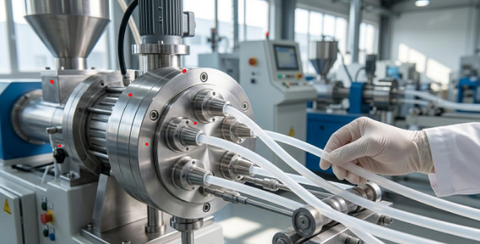
A wire extrusion line applies insulating or protective material around a conductor. Polymer materials such as PVC, polyethylene, and cross-linked polyethylene are used depending on cable requirements.
5. Cable Armoring Machine
A cable armoring machine applies protective metal layers around a cable. Steel wires or metal tapes may be used to improve mechanical protection against external pressure and physical damage.
Main Stages of Cable Manufacturing
Step-by-Step Production Process
Cable manufacturing involves several connected stages. Each operation prepares the material for the next manufacturing activity.
Raw Material Preparation: Copper or aluminium materials are inspected and prepared for processing. Insulating compounds and other required materials are also selected according to the cable design.
Wire Drawing: Metal rods pass through drawing dies to achieve the required wire diameter. Lubrication and controlled machine settings help maintain surface quality.
Bunching and Stranding: Individual wires are combined or twisted into conductor structures. The required arrangement depends on flexibility, conductor size, and electrical application.
Insulation Extrusion: The conductor passes through an extrusion system where heated polymer material forms an insulating layer around it. Cooling equipment then helps the insulation solidify.
Cable Assembly: Multiple insulated conductors may be arranged together to form multicore cables. Filling materials and binding layers can be added when required.
Armoring and Outer Sheathing: Protective metal layers and outer polymer coverings are applied according to the cable construction.
Testing and Packaging: Finished cables undergo dimensional, electrical, and visual inspections before being wound onto reels or drums.
Cable Manufacturing Process Overview
| Manufacturing Stage | Main Equipment | Primary Function |
|---|---|---|
| Wire preparation | Wire drawing machine | Reduces wire diameter |
| Wire combination | Bunching machine | Groups individual wires |
| Conductor formation | Stranding machine | Twists conductor strands |
| Insulation | Extrusion line | Applies polymer insulation |
| Cable protection | Armoring machine | Adds mechanical protection |
| Final inspection | Testing equipment | Checks product quality |
Recent Developments in Cable Manufacturing Technology
Automation and Digital Monitoring
During 2025 and 2026, cable manufacturing technology has increasingly focused on automation, digital monitoring, and production consistency. Modern equipment can integrate sensors, programmable controls, and measurement systems to monitor important operating conditions.
For example, online diameter measurement can help identify dimensional variations during wire drawing and extrusion. Automated handling systems can also support material movement and reduce repetitive manual operations.
Advanced Extrusion and Smart Manufacturing
Modern cable extrusion systems are developing improved temperature controls, material handling arrangements, and digital process monitoring. These technologies help operators observe production conditions and identify possible process deviations.
Other developments include:
Automated conductor handling and winding systems.
Real-time production monitoring and data collection.
Predictive maintenance for industrial machinery.
Improved material management and energy monitoring.
Flexible extrusion equipment for different cable constructions.
These developments are gradually changing how manufacturing facilities organise and monitor their production operations.
Laws, Standards, and Manufacturing Safety
Important Cable Manufacturing Standards
Cable production must follow relevant technical requirements depending on product type, application, voltage rating, and destination market.
International standards provide guidance on cable construction, dimensions, testing, and performance. For example, IEC 60502-1 covers certain power cables with extruded insulation rated at 1 kV and 3 kV. IEC 60502-2 addresses specified power cables rated from 6 kV to 30 kV.
Manufacturers may also need to consider applicable national standards, electrical safety regulations, environmental requirements, and product certification rules.
Workplace Safety Considerations
Cable manufacturing facilities use rotating machinery, heated extrusion equipment, electrical systems, and heavy material-handling equipment. Appropriate workplace procedures are therefore important.
Common safety practices include:
Installing machine guards and emergency stopping systems.
Providing suitable protective equipment for operators.
Monitoring electrical connections and heating systems.
Maintaining ventilation around material-processing areas.
Following equipment inspection and maintenance schedules.
Tools and Resources for Understanding Cable Production
Equipment and Technical Resources
Understanding industrial cable machinery becomes easier through technical documentation, equipment diagrams, and manufacturing process references.
Useful learning resources include:
Machine manuals: Explain equipment operation, maintenance, and safety requirements.
Production flow diagrams: Show how materials move between manufacturing stages.
Material specifications: Describe conductor metals, insulation compounds, and protective materials.
Quality testing guides: Explain electrical and mechanical inspection methods.
Technical standards: Provide information about relevant cable construction and testing requirements.
These resources help students, technicians, and manufacturing professionals understand the relationship between individual machines and complete production systems.
Frequently Asked Questions
1. What machines are used in a cable production line?
Common equipment includes wire drawing machines, bunching machines, stranding machines, extrusion lines, armoring machines, cooling systems, and cable winding equipment.
2. What is the function of a cable extrusion line?
A cable extrusion line applies insulating or protective polymer material around electrical conductors. It helps create a consistent covering according to the cable design.
3. What is the difference between bunching and stranding?
Bunching groups several wires together, generally without a controlled helical arrangement. Stranding twists wires into a structured conductor configuration.
4. Which materials are commonly used in cable manufacturing?
Copper and aluminium are common conductor materials. PVC, polyethylene, and cross-linked polyethylene are frequently used for insulation and protective coverings.
5. How is cable quality checked during manufacturing?
Quality checks may include conductor resistance measurements, insulation thickness inspection, dimensional testing, electrical testing, and visual examination.
Conclusion
Cable production lines combine specialised machinery and manufacturing stages to produce different types of electrical and communication cables. Wire drawing, bunching, stranding, extrusion, armoring, and testing each contribute to the final cable structure.