Industrial Automation Equipment Systems: Automation Technology Overview
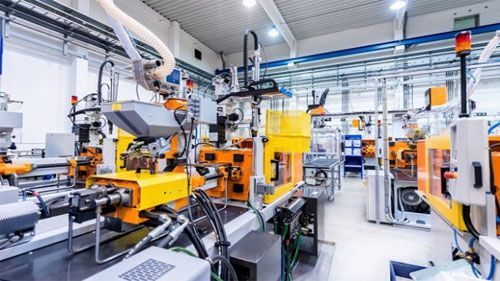
Industrial automation equipment systems are technologies used to monitor, control, and coordinate machines and industrial processes with limited manual intervention. They can range from individual sensors and motor drives to complete automated production lines.
The main purpose is to make industrial processes more consistent, measurable, and easier to control. Automation can be applied in manufacturing, packaging, food processing, pharmaceuticals, electronics, automotive production, energy, logistics, and many other industries.
A typical industrial automation system may include:
- Programmable Logic Controllers (PLCs)
- Human-Machine Interfaces (HMIs)
- Industrial sensors
- Variable frequency drives
- Servo motors and motion controllers
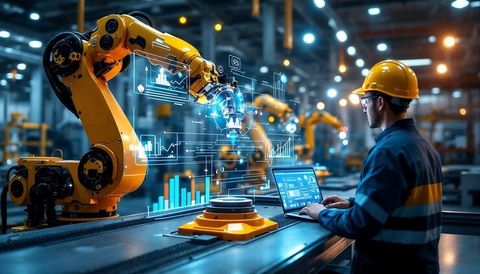
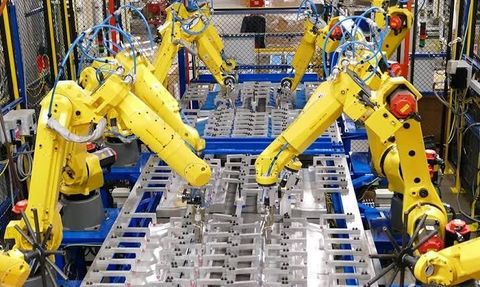
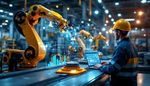
- Industrial robots
- Remote I/O modules
- Industrial communication networks
- Supervisory Control and Data Acquisition (SCADA) systems
- Manufacturing data and monitoring software
These components work together as a connected system. Sensors collect information from machines or production processes. Controllers interpret that information and determine what should happen next. Actuators, motors, valves, and other equipment then carry out the required action.
The development of automation has moved from simple mechanical controls toward programmable, connected, and data-driven systems. Modern industrial automation increasingly combines control engineering with industrial networking, robotics, artificial intelligence, and digital monitoring.
How an Automation System Works
An industrial automation system generally follows a continuous cycle:
Sense → Process → Decide → Act → Monitor
For example, a sensor may detect the position of a product on a conveyor. The PLC receives that signal and checks the programmed conditions. A motor or pneumatic actuator can then move the product to the required location. An HMI may display the operating status to an operator.
This structure allows manufacturers to monitor processes while maintaining defined operating conditions.
Why Industrial Automation Matters Today
Importance for Modern Manufacturing
Industrial automation equipment systems have become important because manufacturers need greater process control, reliable production data, and flexible equipment.
Automation can help address several common industrial challenges, including:
- Repetitive manual operations
- Inconsistent process conditions
- Equipment monitoring difficulties
- Production interruptions
- Limited visibility into machine performance
- Complex material movement
- Safety risks around hazardous operations
- Increasing demand for accurate production data
Automation does not necessarily mean removing people from industrial processes. In many applications, workers remain responsible for supervision, programming, maintenance, quality control, decision-making, and system improvement.
Who Uses Industrial Automation?
Automation technologies are used by organizations across many sectors.
| Industry | Common Automation Applications |
|---|---|
| Automotive | Robotic assembly, welding, inspection |
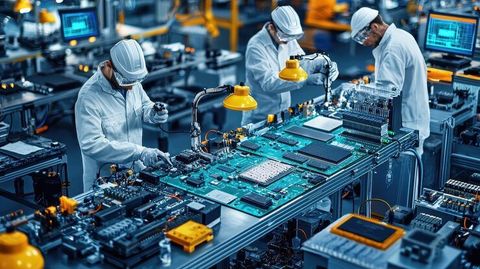
| Electronics | Precision assembly and testing |
| Food Processing | Packaging, filling, temperature control |
| Pharmaceuticals | Process monitoring and batch control |
| Textiles | Machine control and production monitoring |
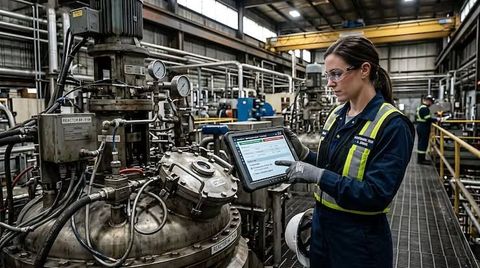
| Chemicals | Process control and safety monitoring |
| Logistics | Conveyors, sorting, warehouse automation |
| Energy | Monitoring, control, and equipment protection |
Industrial automation also supports data collection. Production information can be analyzed to identify recurring equipment problems, process variations, energy patterns, and maintenance requirements.
Role of Industrial IoT
Industrial Internet of Things technologies connect machines, sensors, controllers, and software platforms. This allows operational information to move between equipment and monitoring systems.
For example, vibration sensors can provide information about rotating equipment. Temperature sensors can monitor process conditions. Energy meters can track electrical consumption. When this information is organized properly, it can support condition monitoring and maintenance planning.
Recent Automation Trends and Updates
Growth of AI, Robotics, and Digital Twins
During 2025 and 2026, industrial technology discussions increasingly focused on artificial intelligence, robotics, digital twins, and advanced manufacturing.
In October 2025, NITI Aayog presented a manufacturing roadmap identifying artificial intelligence and machine learning, advanced materials, digital twins, and robotics as important technologies for advanced manufacturing across multiple sectors.
Digital twins are particularly useful for creating a digital representation of a machine, production line, or process. They can help engineers examine operating conditions and evaluate potential changes before modifying physical equipment.
AI for Manufacturing Engineering
In February 2026, India's Ministry of Electronics and Information Technology highlighted AI for Manufacturing Engineering Technology, with emphasis on responsible AI adoption, skills development, and scalable implementation.
This reflects a broader movement toward combining traditional automation with data analytics and AI-based technologies.
AI can potentially support applications such as:
- Visual quality inspection
- Anomaly detection
- Predictive maintenance
- Production data analysis
- Process optimization
- Equipment monitoring
These applications still require appropriate data, testing, system validation, and human oversight.
Manufacturing Policy Developments
The National Manufacturing Mission was announced in India's Union Budget 2025–26. Its focus areas include technology availability, quality products, MSMEs, workforce development, and manufacturing competitiveness.
In May 2026, the government also released implementation guidelines for the BHAVYA scheme, which focuses on developing integrated industrial parks and manufacturing infrastructure.
Together, these developments indicate continued policy attention toward manufacturing technology, infrastructure, and industrial modernization.
Laws, Standards, and Policies in India
Machinery Safety Requirements
Industrial automation equipment must be considered alongside machinery and electrical safety requirements. India's regulatory environment has been evolving during 2025 and 2026.
The Ministry of Heavy Industries has published amendments and updates concerning the Machinery and Electrical Equipment Safety framework. Its official records show a second amendment issued in November 2025 and a withdrawal of the 2024 principal order recorded in January 2026.
Because the regulatory position can change, manufacturers and equipment users should verify the latest applicable notification before relying on an earlier implementation date.
BIS Standards and Certification
The Bureau of Indian Standards maintains certification and product-specific guidance for several categories of machinery and electrical equipment. Its published information includes machinery categories such as metal-cutting machines, rubber and plastics machinery, semiconductor converters, and weaving machines.
Machine safety commonly involves principles such as:
- Risk assessment
- Risk reduction
- Protective measures
- Emergency stopping
- Electrical safety
- Control-system safety
- Appropriate documentation
The specific requirements depend on the equipment category, intended application, and applicable Indian Standard.
Integrated Manufacturing Systems
BIS also published a 2025 draft revision concerning safety requirements for integrating machinery into a manufacturing system. The draft aligns with ISO 11161:2025 and addresses areas such as risk assessment, system layout, task zones, and risk-reduction measures.
For industrial automation projects, safety should therefore be considered during system design rather than treated only as a final inspection activity.
Tools and Resources for Automation Planning
Automation Design Tools
Several types of general-purpose tools can help engineers and technical teams plan automation systems:
- PLC programming environments
- HMI design software
- SCADA platforms
- Electrical circuit design tools
- Industrial network configuration tools
- Motion-control configuration software
- Robot programming environments
- Digital-twin and simulation platforms
- Data visualization dashboards
Useful Calculators and Templates
Basic engineering calculators can also help during preliminary planning. Common examples include:
- Motor sizing calculators
- Conveyor capacity calculators
- Electrical load calculators
- Power and energy calculators
- Pneumatic flow calculators
- Sensor selection worksheets
- Production-cycle calculation templates
- Preventive-maintenance checklists
- Risk-assessment templates
These tools can support planning, but final equipment selection and safety decisions should be based on the relevant engineering specifications and applicable standards.
Learning Resources
People learning industrial automation can start with foundational subjects such as:
- PLC fundamentals
- Industrial electrical systems
- Sensors and instrumentation
- Motor control
- Industrial networking
- Robotics
- HMI and SCADA
- Machine safety
- Industrial cybersecurity
- Data analytics for manufacturing
A step-by-step learning path is often easier to understand than trying to study every automation technology at once.
Frequently Asked Questions
What are industrial automation equipment systems?
Industrial automation equipment systems are combinations of hardware and software used to monitor, control, and coordinate industrial machines and processes. They may include PLCs, sensors, HMIs, drives, robots, controllers, and communication networks.
What is the role of a PLC in automation?
A PLC is a programmable controller that receives signals from sensors and other devices, processes programmed logic, and sends control signals to machines or actuators. PLCs are widely used for sequential and real-time industrial control.
What is the difference between PLC, HMI, and SCADA?
A PLC primarily controls equipment and processes. An HMI provides an interface through which people can view information and interact with a machine. SCADA is generally used for broader supervisory monitoring, data collection, alarms, and process visualization.
Is AI replacing traditional industrial automation?
AI is generally being integrated with traditional automation rather than simply replacing it. PLCs, sensors, drives, robots, and control systems remain important, while AI can add capabilities such as anomaly detection, inspection, and data analysis.
Why are safety standards important in automation?
Automation systems can involve moving machinery, electricity, pressure, heat, and other hazards. Safety standards provide structured approaches for identifying risks and applying appropriate protective measures. The exact requirements depend on the equipment and application.
Conclusion
Industrial automation equipment systems are an important part of modern manufacturing and process control. They combine sensors, controllers, drives, robots, software, and communication technologies to create coordinated industrial processes.